
 United States
 United Kingdom
 Canada
 Australia
 New Zealand
 Ireland
German household debt sharpens Vorbach's criticism of Merz's spending plans
The commentator connects unfulfilled tax promises with financial pressure on households, then challenges proposals to publicly identify climate misinformation.
 CDU UND MERZ AM ABGRUND: "Und das bringt mich doch sehr zum Lachen" - Deutschlands Schulden-Schock!
Up next

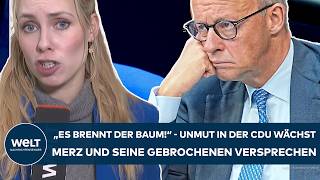

 GermanyStory of
Why this story? One of WELT Nachrichtensender's most watched videos since yesterday, with 120,253 views.
WELT Nachrichtensender: The German news channel WELT, formerly N24, owned by the media group Axel Springer. 2.5M subscribers and 5.9B views.
2 more stories on Germany's electricity-tax cut dispute ›
Things we can learn from the video
Press to jump
- 0:26Vorbach argues that unfulfilled electricity-tax relief and debt-financed spending have damaged Merz's and the Union's credibility.
- 2:08Citing the Schuldneratlas, he says 7.4 million adults are overindebted, with people in their thirties particularly affected.
- 3:33He criticizes a Baden-Württemberg proposal that he characterizes as publicly identifying climate critics.
- 5:28A population-based doomsday forecast from 1960 becomes his example of the limits of long-range predictions.
Household financial distress gives Sebastian Vorbach's criticism of Germany's government a second focus beyond its disputed electricity-tax promise: the people already unable to meet their obligations.
In a studio commentary on Germany's WELT Nachrichtensender, the editor cites the Schuldneratlas debt survey as finding that 7.4 million adults are overindebted, with people in their thirties particularly affected. He places that finding alongside an argument that Chancellor Friedrich Merz's government is borrowing more without delivering the reforms or relief it promised.
Merz leads the centre-right Christian Democratic Union, or CDU. Vorbach argues that the credibility of both the chancellor and the Union, the CDU and its Bavarian sister party, has already been damaged. His complaint is not simply that a promised electricity-tax reduction has failed to materialize: he says the government's broader combination of spending, debt and insufficient reform contradicts its earlier commitments.
Vorbach puts the proposed electricity-tax saving for an average four-person household at eight euros a month. In his account, the political significance lies less in that sum than in whether voters can trust a promise of relief.
The discussion then turns to Fridays for Future climate demonstrations and a proposal in Baden-Württemberg that Vorbach characterizes as a register targeting climate critics. He objects to publicly singling people out and frames the issue as one of political paternalism and the boundaries of acceptable debate. This is his interpretation of the proposal, rather than a detailed account of its provisions.
For his closing example, Vorbach revisits a population-based doomsday forecast published in 1960. He argues that changing population growth undermined its prediction, using the example to question the certainty attached to long-range forecasts. The segment ends with the presenters exchanging lighter remarks about reaching Friday without the world ending.
Germany’s chancellor since May 2025 and leader of the Christian Democratic Union (CDU) since January 2022.
More on Wikipedia ›Germany’s main centre-right party, with Christian democratic and conservative roots. It is led by Chancellor Friedrich Merz.
More on Wikipedia ›An international student movement whose participants miss Friday classes to demand political action on climate change and a shift from fossil fuels to renewable energy.
More on Wikipedia ›Published on Trari
Where next?
What do you think?
Want to know when somebody answers you?
- Channel
- WELT Nachrichtensender
- Subscribers
- 2,500,000 ▲ 10,000 this week
- Channel views, last 7 days
- 27,476,967
- Channel views, pace per day
- 6,163,893 (on a normal day: 3,834,419)
- Video published
- November 13, 2026
- Video views so far
- 120,253 (less than a day online)
- Video views, pace per day
- 132,719
The numbers
The commentary drew about 120,000 views since yesterday, placing it among Germany's most-watched new videos from leading news channels.

💡 Test your knowledge
In which country did Greta Thunberg begin the school strike that inspired Fridays for Future?
Thunberg began her school strike outside Sweden's parliament in Stockholm in 2018.