
Abdul El-Sayed tells Jon Stewart his father "studied my life into existence"
The Michigan Senate nominee traces a path from his Egyptian immigrant family and a hospital career to "civic chiropractics" on the campaign trail.
 The Weekly Show with Jon Stewart
Story of
Why this story? The video opened at a pace of 632,810 views a day, 16 times a normal first day on this channel (40,840).
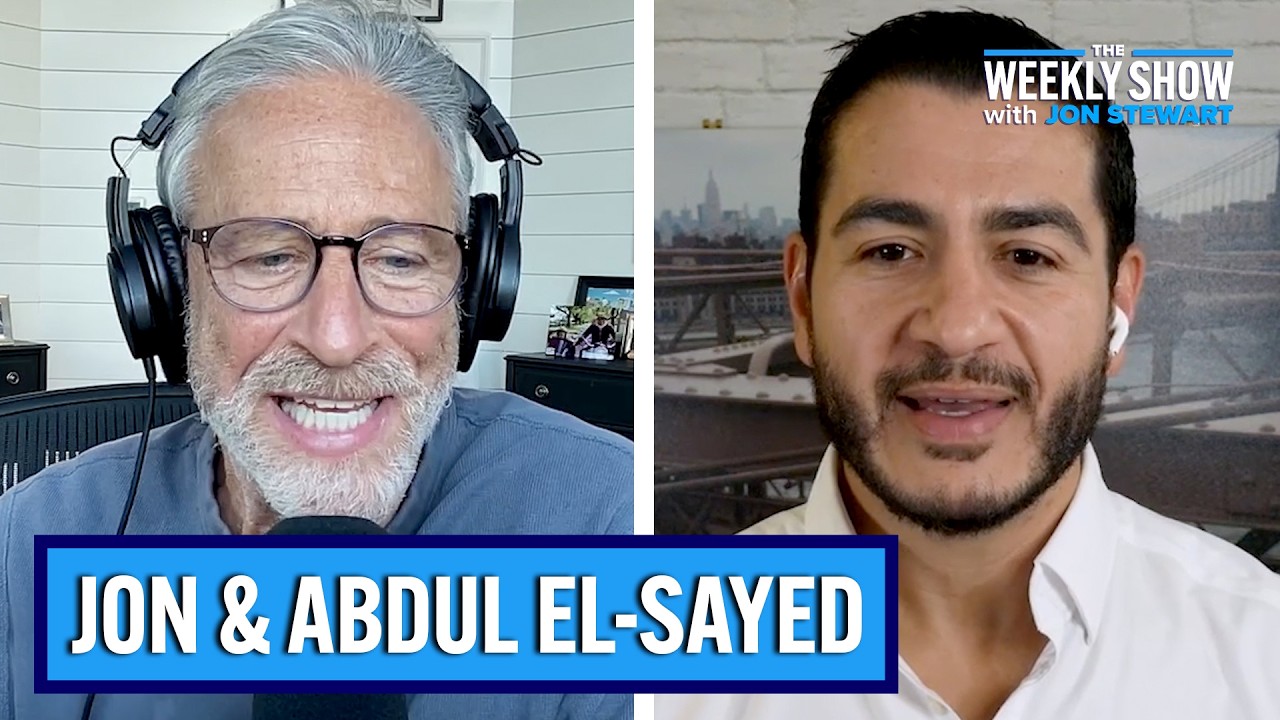 Abdul El-Sayed’s Progressive Policy Prescription | The Weekly Show with Jon Stewart
Things we can learn from the video
Press to jump
- 2:36El-Sayed says his campaign started in April 2025 and describes crisscrossing Michigan.
- 7:50He explains "civic chiropractics": naming a shared pain so voters feel heard.
- 8:44Voters' top worries, he says, are healthcare costs, eldercare and AI threatening jobs.
- 15:48Why he left medicine: illness is driven by systems, so he wanted to work on them.
- 29:22He says his primary campaign was outspent 11 to 1 and addresses attack ads.
- 57:26He contrasts voters' policy questions with reporters' sensational gotcha questions.
Abdul El-Sayed's father had a simple rule at home: "no A no play." On the new Weekly Show, the Michigan Democratic Senate nominee tells Jon Stewart that his father, who came from Egypt, "literally studied my life into existence," and that a family from "a place where there is no democracy" is part of why he is on the ballot.
The episode went up hours ago and has already passed 350,000 views in its first nine hours. On this channel, a full episode usually collects around 40,000 in an entire first day. A Short from the same conversation, "El-Sayed On GOP Attacks," is also moving well ahead of the channel's usual pace for Shorts.
Stewart opens by admitting to nerves about the election two weeks away. El-Sayed, who says his campaign began in April 2025, describes what he hears in living rooms and at town halls: worries about the cost of healthcare, caring for aging parents and whether AI will take people's jobs. Good politics, he argues, means surfacing a pain people share and acknowledging it, something he calls "civic chiropractics."
The doctor in him shows. He left medicine for public health because, he says, "you needed to be the kind of doctor that worked on the system and not just in the system." He recalls giving his college graduation speech on the same stage as Bill Clinton, who told him he had a gift for communicating, and the pull of Barack Obama's 2004 convention speech.
Later the talk turns harder. El-Sayed says his primary campaign was outspent 11 to 1, and he answers attacks aimed at his Muslim faith and immigrant background. Stewart brings a grudge of his own against former Michigan congressman Mike Rogers, dating to the 2010 fight over the Zadroga 9/11 health bill, the cause Stewart championed for first responders. The guest closes on a contrast he clearly feels: the questions voters ask him, and the gotcha questions he gets from reporters.
Published on Trari
Where next?


 Is this your channel?For the channel's owners and team: a ready picture, text and badge for your audience
Share the story with your audience. Everything is ready:
For an Instagram story or a WhatsApp status
For a community post or your channel's description
For your website

You may use the picture, the badge, and link it to this story.
- Subscribers
- 887,000 ▲ 4,000 this week
- Channel views, last 7 days
- 1,220,829
- Video published
- October 21, 2026
- Video views so far
- 358,427 (less than a day online)
- Video views, pace per day
- 632,810
The numbers
This episode started roughly fifteen times faster than a usual full Weekly Show upload, and a companion Short from the same interview is also running well ahead.

💡 Test your knowledge
Barack Obama's 2004 Democratic convention speech, which El-Sayed mentions, was delivered in which city?
The 2004 Democratic National Convention, where Obama gave his breakout keynote, was held in Boston.