
 United States
 United Kingdom
 Canada
 Australia
 New Zealand
 Ireland
Veritasium puts a model cargo ship in a rogue wave
Henry van Dyck and Emilia Gyles trace the towering Draupner wave from a North Sea platform to the lab.
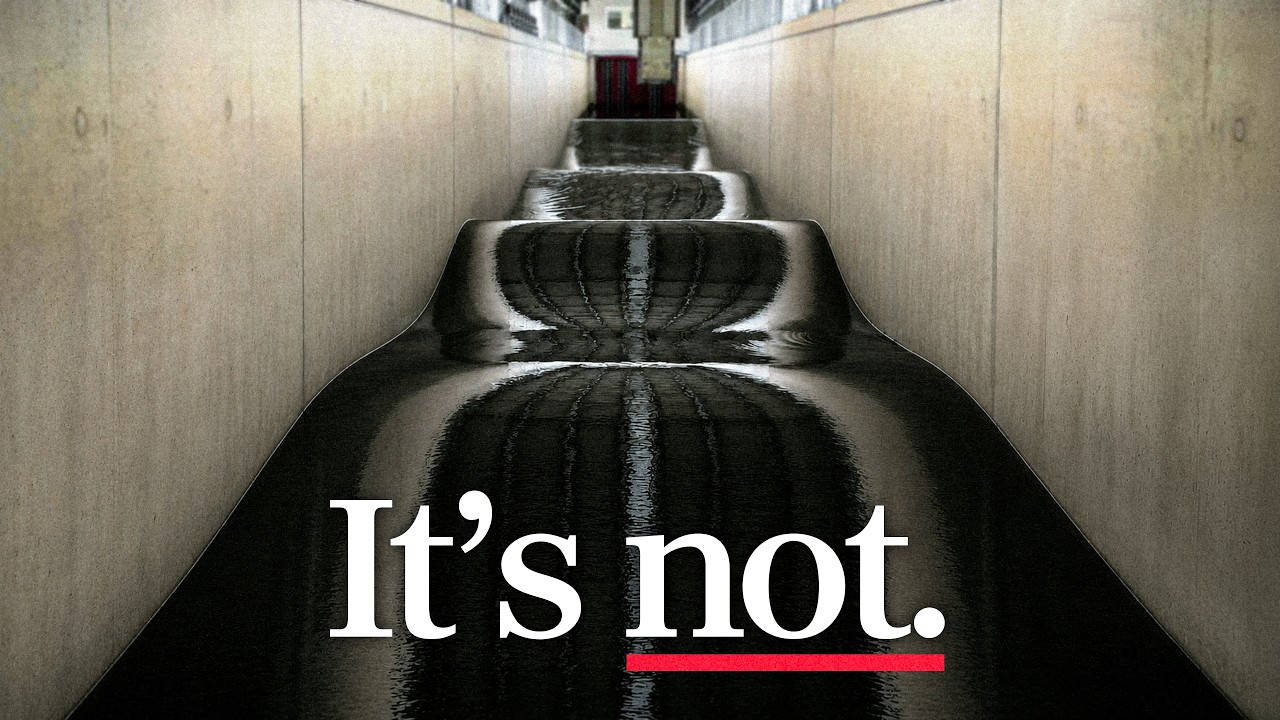 Scientists Said This Wave Was Impossible
Up nextTrari.com home page ›


 Veritasium
Story of
No. 48 on the daily chartNo. 3 on the Science chart
Why this story? The channel's weekly summary: what went up this week, what is drawing views now, and where the channel stands among similar channels.
The paddle starts with the shortest waves. They don't look like much on their own, but in Veritasium's "Scientists Said This Wave Was Impossible," the pieces come together in the tank to make a rogue wave with a model cargo ship in its path. It's the hands-on answer to the film's opening puzzle: how did a crest more than 25 meters high rise out of the North Sea at the Draupner platform?
Henry van Dyck and Emilia Gyles take the story from satellite radar to the flumes at Imperial Hydrodynamics Laboratory. Amin Chabchoub of the Okinawa Institute of Science and Technology explains how wave groups can draw energy from their neighbors, and the film shows how waves crossing at an angle can build an exceptionally steep crest. There's a sponsored shake-table segment at the end. In the comments, sailors share memories of walls of water, while other viewers pick up on the flip side of a rogue crest: an unusually deep trough, or rogue hole.
The film has drawn more than nine million views and is still Veritasium's busiest upload by daily views. The other new upload, the paid partnership "Can a roll of tape really make X-rays?", starts with tape tugging at the presenter's arm hair. Unwind it quickly in the dark and it glows blue; in a vacuum, peeling tape can produce enough X-rays to image a finger, as UCLA researchers demonstrated.
Subscribers held steady this week, but views rose more across Veritasium than across any of its nearby science channels, with Cleo Abram drawing a similarly large weekly audience and The Slow Mo Guys having a quieter week. The wave film isn't doing all the work: Derek Muller's liquid-helium documentary, where a superfluid creeps up and out of its cup, is next by daily views, followed by Gregor Čavlović's explainer on randomness.
Published on Trari.com
Go back to Trari.com home page
Where next?
Things we can learn from the video
Press to jump
- 0:00Sensors on the Draupner platform recorded a 25.6-meter wave in the North Sea.
- 1:00The MaxWave project used satellite radar to confirm rogue waves around the world.
- 11:15John Scott Russell observed a solitary wave that held its shape as it traveled along a canal.
- 17:16Wave components converge in the tank to create a rogue wave against a model cargo ship.
- 19:24Amin Chabchoub explains how a wave group can grow by drawing energy from neighboring waves.
- 22:05Crossing seas can produce crests steeper than standard breaking limits would suggest.
A professional in this field? Want to write about Science & learning on Trari? Tell us ›
What viewers say
I’ve actually experienced a rogue wave, it’s terrifying! I was in the US Navy for 6 years, and the destroyer I was stationed on got hit by a rogue wave in the middle of the night, while I was at the helm. While I was looking out the front window, a wall of water appeared right in front of us. Thankfully there was no damage to our ship, and the guys on the bridge wings were able to get inside before it hit.
@ForOdinSee it on YouTube0:55 Since then we've also discovered that krakens (giant squids) exist as well. So by extrapolation it's only a matter of time before we find mermaids.
@chilverscSee it on YouTubeThe Draupner measurement is the part that stuck with me — a 25.6-metre wave rising out of a sea where everything else was around 12 metres, and it was actually recorded, not just a sailor's story. The explanation of wave groups stealing energy from their neighbours finally made superposition feel physical rather than abstract. Brilliant use of the wave tank to show it happening instead of just describing it.
@BuildLogicHQSee it on YouTube
3 more comments
The resemblance between the photo at 26:14 and the painting "The Great Wave off Kanagawa" is uncanny! It suggests that what folks have typically dismissed as the artist's fantasy in the painting might just be a portrait of something much more real.
@bradarmstrong3952See it on YouTubeThe ship named astrolabe almost getting hit by a rogue wave on its way to the d'urville station feels like the sea finishing the story
@DubDoseDubbingAgencySee it on YouTube"All models are wrong, but some are useful"
- George Box@FloofFolfSee it on YouTube
Public comments from the video's page on YouTube
Want to know when somebody answers you?
 For the channel's owners and team
Share the story with your audience
A ready picture for an Instagram story or a WhatsApp status.
Ready text for a community post
The videos drawing views on Veritasium right now


- Channel
- Veritasium
- Subscribers
- 21,500,000
- Channel views, last 7 days
- 23,099,987
- Videos published this week
- 2
- Video published
- November 25, 2026
- Video views so far
- 9,434,913
- Views on its first day
- 5,089,125
The numbers
Here's how Veritasium's views, subscribers, and new uploads stacked up this week.

💡 Test your knowledge
Which physicist discovered X-rays, a milestone revisited in Veritasium's tape demonstration?
Wilhelm Röntgen discovered X-rays in 1895 while experimenting with a cathode-ray tube.