
Craige Hoover's case for neighborhoods that let strangers meet
The Franklin developer blames rigid zoning for American loneliness and points to an improv theater in Seaside, Florida, as a different model.
 TEDx Talks
Story of
Why this story? The video opened at a pace of 54,603 views a day, 128 times a normal first day on this channel (426).
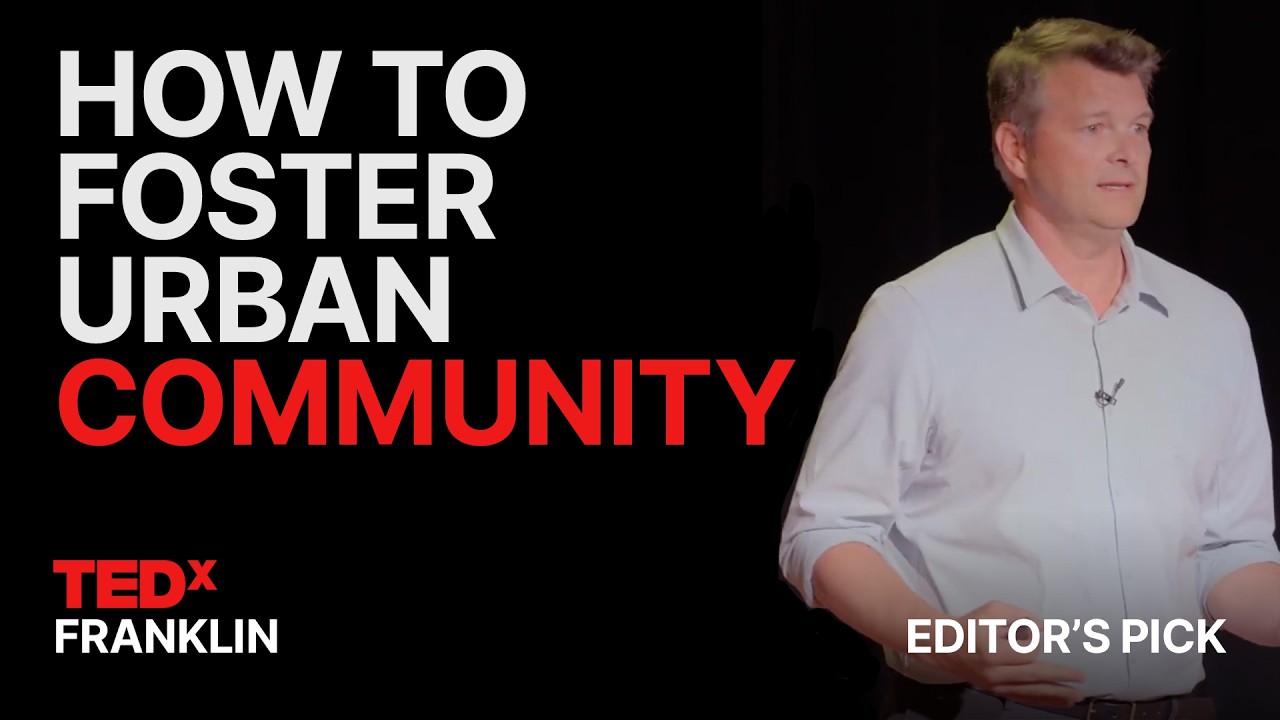 Why do cities make us lonely? | Craige Hoover | TEDxFranklin
Things we can learn from the video
Press to jump
- 0:19Hoover describes living a full week without meeting anyone new, and how easy it was.
- 2:41A chart shows Americans' trust in each other falling over fifty years; he links trust to casual encounters.
- 3:36Citing Raj Chetty, he says connections across income groups best predict upward mobility.
- 4:33He compares single-use suburban zoning to farm monocultures: fragile and unable to adapt.
- 6:33His improv theater in Seaside, Florida, shows what flexible, "generous" design allowed.
- 8:44He urges towns to loosen rigid codes, saying a city's job is to manage change, not prevent it.
Craige Hoover once went an entire week without interacting with anyone new. The unsettling part, as he tells it at TEDxFranklin, was how easily ordinary American life let him do it. "We've engineered a society where you can go days, weeks, without encountering a single person that you don't already know," he says.
The talk, "Why do cities make us lonely?", passed 40,000 views in its first fifteen hours. A regular TEDx Talks upload usually draws a few hundred on its first day. It joins two other recent talks that have each passed 50,000: Blaise Kimmel's on cancer immunotherapy and TJ Nealy's on leaning too hard on AI. Two talks from the University of Suffolk, posted the same week, sit near 2,000.
Hoover is a real estate developer, and his argument starts with trust. He shows a chart of how few Americans now say most people can be trusted, and ties the decline to how rarely we bump into each other. "Trust comes from proximity," he says. He then cites Harvard economist Raj Chetty's finding that friendships across income groups are the strongest predictor of a child's chances of moving up.
His main target is zoning. Neighborhoods built for a single use, he argues, are like agricultural monocultures: efficient on paper, fragile in practice. "And monocultures don't last."
His best example is personal. In Seaside, Florida, he started an improv theater company, and he credits the town's developer, Robert Davis, with letting small, informal businesses grow on their own instead of fixing every use in advance. Hoover calls it "generous design."
Not every viewer accepts the premise; some of the most-liked comments say city life has never made them lonely. Hoover's answer is less about forcing connection than making room for it, and he closes on his own project, Armistead, a farm-centered, mixed-use community in Franklin, Tennessee. His standard for it: "We should not expect perfect places, but we should demand generous ones."
Published on Trari
Where next?


What viewers say
Cities don’t make us lonely, we make ourselves lonely. And I been living in the city my whole life and definitely don’t feel it at all.
@Create2moroSee it on YouTubeGreat talk 🎉
@coolsheepSee it on YouTubewhen will Ted Talks?
@QuốcAnhPhạm-f1j4qSee it on YouTube
Public comments from the video's page on YouTube
 Is this your channel?For the channel's owners and team: a ready picture, text and badge for your audience
Share the story with your audience. Everything is ready:
For an Instagram story or a WhatsApp status
For a community post or your channel's description
For your website

You may use the picture, the badge, and link it to this story.
- Channel
- TEDx Talks
- Subscribers
- 44,700,000
- Channel views, last 7 days
- 12,220,315
- Channel views, pace per day
- 1,660,564 (on a normal day: 1,884,899)
- Video published
- October 18, 2026
- Video views so far
- 42,617 (less than a day online)
- Video views, pace per day
- 54,603
The numbers
A start this fast is far from routine for a TEDx Talks upload, even on a channel with more than 44 million subscribers.

💡 Test your knowledge
In which state is Franklin, where Hoover gave this talk and is building his new community?
Franklin is a city in Tennessee, south of Nashville, and the talk's own description places Hoover's Armistead project there.