
 United States
 United Kingdom
 Canada
 Australia
 New Zealand
 Ireland
Burnham pitches his EU reset. Badenoch questions the savings
The Treasury's growth estimate got the big billing, but the Commons exchange turned on what shoppers might pay at the checkout.
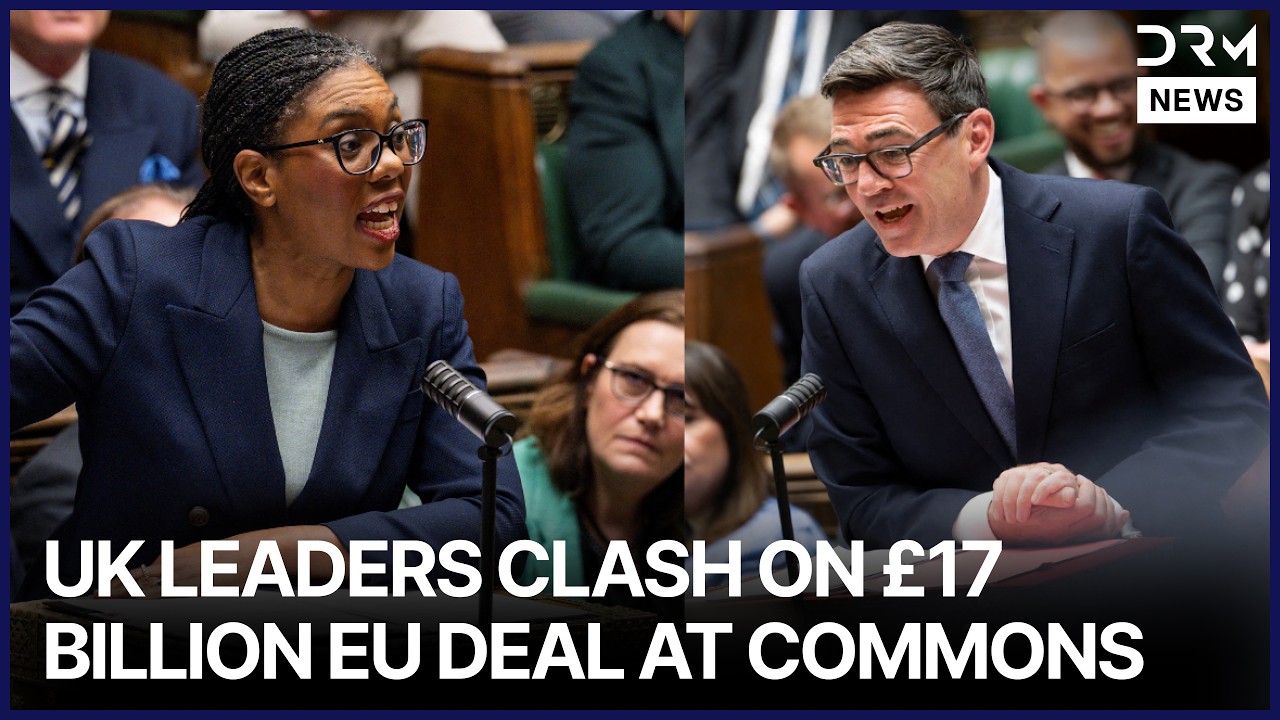 Andy Burnham and Kemi Badenoch Clash Over £17 Billion EU Deal in Fiery Commons Showdown | AC1G
Up nextTrari.com home page ›


 DRM News
Story of
Why this story? The video opened at a pace of 60,267 views a day, 21 times a normal first day on this channel (2,864).
The £17 billion in the DRM News headline is not the price of the deal. It's the upper end of a Treasury estimate, cited by Prime Minister Andy Burnham, for how much the agreement with the European Union could add to Britain's economy each year.
Burnham made his case in the House of Commons with examples ranging from food exporters to touring musicians. Alongside his party's manifesto commitments and the question of whether the deal improved on the existing Brexit terms, he set what he called the "Makerfield test," named after the Greater Manchester constituency he represents. When he returned to it later, his pitch was about costs and cooperation at the border.
Conservative leader Kemi Badenoch argued that the deal would leave Britain following rules set in Brussels without a mandate to do so. She also drew on statements from retail and produce trade groups to challenge the idea that the agreement would bring down food prices.
The Commons clip drew more than 41,000 views in half a day, far beyond what a regular DRM News upload usually gets in a full day. In the comments, some viewers put the question more simply: when, if at all, would they notice a difference in the cost of their weekly shop?
Burnham has been the UK’s prime minister and Labour Party leader since July 2026. He represents Makerfield in Parliament.
More on Wikipedia ›Badenoch has led the Conservative Party and served as the UK’s Leader of the Opposition since 2024. She is the MP for North West Essex.
More on Wikipedia ›Published on Trari.com
Go back to Trari.com home page
Where next?
Things we can learn from the video
Press to jump
- 4:49Burnham sets out his tests: keeping manifesto commitments, improving on the existing Brexit deal, and meeting his "Makerfield test."
- 5:37Burnham outlines what the new terms would mean for food exporters, manufacturers, supermarkets, and touring musicians.
- 10:39Burnham cites a Treasury estimate that the deal could add up to £17 billion a year to UK GDP.
- 13:04Badenoch argues that the deal commits Britain to following Brussels rules without a mandate.
- 15:40Badenoch cites retail and produce trade groups to dispute the promise of lower prices and criticizes the youth mobility terms.
- 23:33Burnham says the negotiations secured protections for Britain's car, steel, and aluminum industries.
What do you think?
Want to know when somebody answers you?
 For the channel's owners and team
Share the story with your audience
A ready picture for an Instagram story or a WhatsApp status.
Ready text for a community post
- Channel
- DRM News
- Subscribers
- 996,000 ▲ 6,000 this week
- Channel views, last 7 days
- 11,931,944
- Channel views, pace per day
- 512,292 (on a normal day: 1,559,800)
- Video published
- November 23, 2026
- Video views so far
- 41,454 (less than a day online)
- Video views, pace per day
- 60,267
The numbers
The Commons clip had already drawn far more views and comments than a regular DRM News upload usually gets in its first full day.

💡 Test your knowledge
In which year did the United Kingdom formally leave the European Union?
The UK formally left the EU on January 31, 2020, before its transition period ended that December.